Wire harness assembly is one of the most labour-intensive and quality-critical processes in automotive manufacturing. The cable management components that hold, route, and protect those harnesses must perform reliably across the full vehicle lifetime — typically 15 years or 300,000 km.
Automotive-Grade Requirements
Standard industrial cable ties are not suitable for automotive harness work. Vehicle applications demand:
- IATF 16949 certified supply chain
- RoHS and REACH compliance across all materials
- Temperature resistance: –40°C to +105°C continuous (engine bay grades to +150°C)
- Vibration resistance — ties must not loosen under constant mechanical vibration
- Defined dimensional tolerances for automated harness board assembly
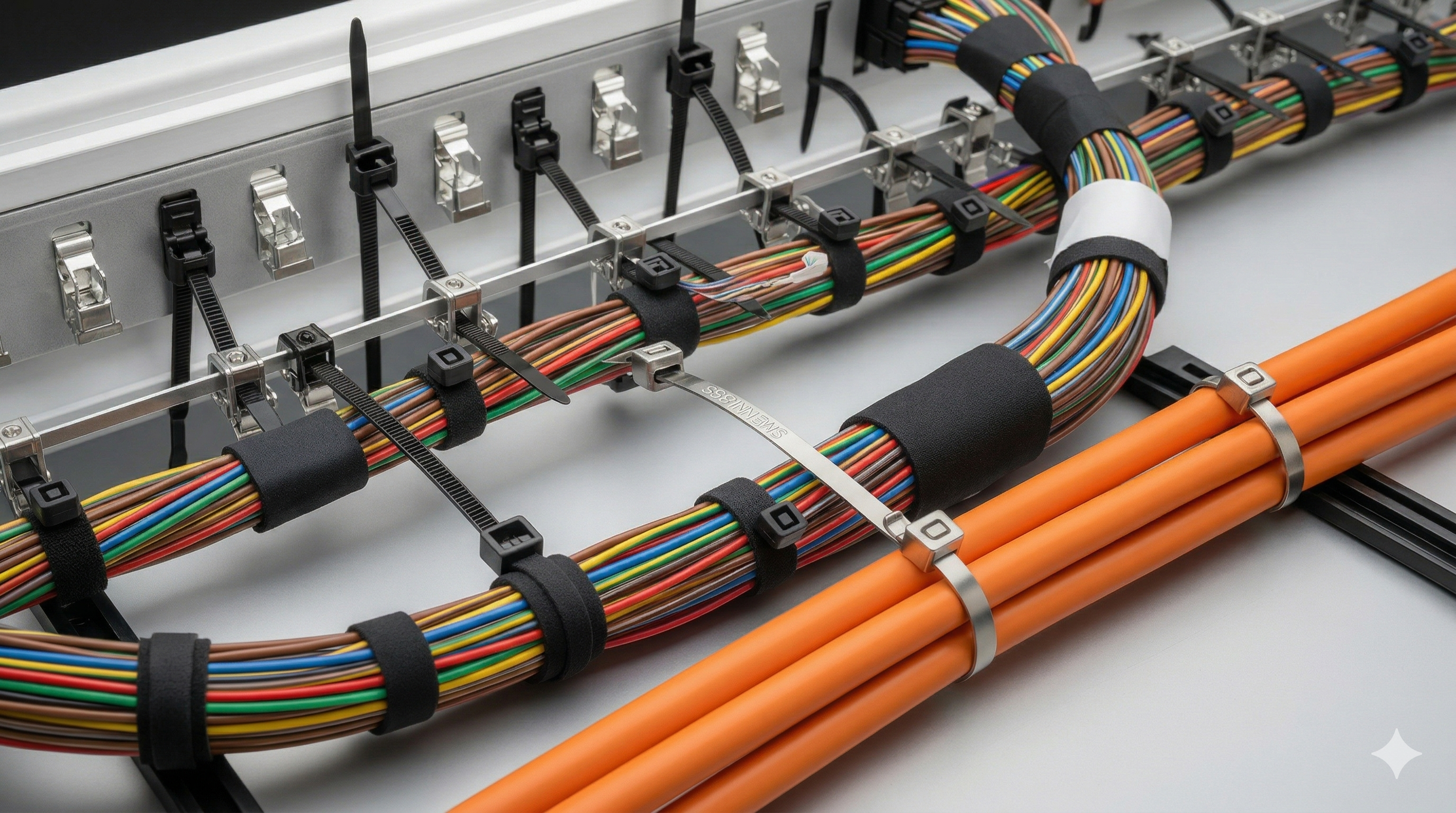
 Automotive wire harness routing requires precise cable management at every bundling and mounting point.
High-Voltage EV Considerations
Battery electric vehicles introduce additional constraints. HV cables (400 V to 800 V DC bus) require:
- Halogen-free, flame-retardant cable ties — thermal runaway events must not be worsened by burning halogenated polymers
- Orange identification ties or conduits — HV wiring must be visually distinguishable per FMVSS and Euro NCAP guidelines
- IP 68 rated cable glands — battery enclosure and charging port penetrations require full waterproofing
- Stainless steel cable ties — for underbody mounting points exposed to road wash and thermal cycling
Novoflex Products for Automotive
Our automotive product range includes IATF 16949 certified Nylon 6.6 cable ties (standard and halogen-free), polyamide cable glands rated to IP 68, push-mount disc ties for panel-free routing, and stainless steel ties for underbody and high-temperature zones.